잡다한 지식
lower_bound & upper_bound 함수
컴영
2020. 7. 12. 17:47
<algorithm> 헤더에 정의되어 있는 함수
1. lower_bound : 범위 안의 원소들 중, value보다 작지 않은(크거나 같은) 첫번째 원소의 위치를 반복자로 반환
이진탐색(binary search) 기반의 탐색법
(이진탐색 기반이므로, 범위 안의 원소들은 정렬된 상태여야 한다.)
사용법
lower_bound(범위 시작 위치, 범위 마지막 위치, value)
2. upper_bound : 범위 안의 원소들 중, value보다 큰 첫번째 원소의 위치를 반복자로 반환
이진탐색 기반의 탐색법
사용법
upper_bound(범위 시작 위치, 범위 마지막 위치, value)
사용코드 예시) vector 사용
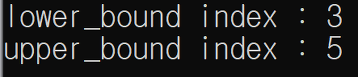
1 2 3 4 5 6 7 8 9 10 11 12 13 14 15 16 17 18 19 20 21 22 23 24 | #include <stdio.h> #include <algorithm> #include <vector> using namespace std; int main() { int arr[8] = { 0,10,20,30,10,20,40,50 }; vector<int> vec(arr, arr + 8); //lower_bound와 upper_bound는 이분탐색 이용 -> 정렬되있어야함 sort(vec.begin(), vec.end()); // 0 10 10 20 20 30 40 50 vector<int>::iterator lower, upper; lower = lower_bound(vec.begin(), vec.end(), 20); // 20 이상인 수의 iterator를 찾음 upper = upper_bound(vec.begin(), vec.end(), 20); // 20 초과인 수의 iterator를 찾음 //인덱스를 출력하려면 lower_bound()-vector.begin(), upper_bound()-vector.begin() printf("lower_bound index : %d\n", lower - vec.begin()); printf("upper_bound index : %d\n", upper - vec.begin()); return 0; } | cs |
출력)
인덱스 |
0 |
1 |
2 |
3 |
4 |
5 |
6 |
7 |
값 |
0 |
10 |
10 |
20 |
20 |
30 |
40 |
50 |
20 이상 값의 첫번째 인덱스 값 : 3
20 초과 값의 첫번재 인덱스 값 : 5